




The short verdict
If you want a modern mattress that cushions shoulders and hips, buy a hybrid. That is what we sleep-test when we review Emma, and it is what most Irish online mattress brands ship in a box. If you want bounce, a cooler less-huggy surface, or you are standing in a showroom looking at a well-made Irish pocket-sprung bed, you do not have to “upgrade” to foam you will hate. The trap is treating the two labels as different coil technologies. They are not. Pocket springs are the support core in both.
Choose a hybrid if…
- You side-sleep, or you share the bed and want more motion isolation than a thin-quilt sprung mattress.
- You want pressure relief and some bounce — the “best of both” pitch is real when the foam stack is actually thick.
- You are buying online (Emma and similar). Those ranges are hybrids, not traditional pocket sprung.
- You will use a trial. Bed-in-a-box hybrids often give you 100–200 nights; many showroom pocket-sprung beds do not.
Choose pocket sprung if…
- You like a traditional Irish mattress: bounce, easier turning, less of a hug.
- You sleep warm and do not want centimetres of memory foam on top of the coils.
- You back-sleep and want that “on top of the bed” support, not a contouring sink.
- You are in a showroom comparing quality Irish-made pocket sprung — and the hybrid on the next stand is just a thicker pillow-top on the same coils.
Health & medical disclaimer
Construction type does not treat or cure pain. If you live with ongoing spinal, joint, or muscular pain, speak with your GP or a chartered physiotherapist before buying on the back of a category guide. See our back pain and orthopaedic guides.
What Irish retailers mean by each label
In 2026 the Irish shop floor still splits beds into “pocket sprung” and “hybrid” as if they were rival technologies. Walk the same aisle in Dreams, Harvey Norman, EZ Living or a local maker and you will see both tickets. Online, Emma and the other boxed brands almost never sell the thin-quilt version — they sell hybrids.
Pocket sprung (the retail category)
Individually wrapped coils — Marshall / pocket springs — with a relatively thin comfort layer: quilted ticking, wool, maybe a light foam. Each spring moves on its own, which is why pocket sprung already beats old open-coil / Bonnell beds for partner disturbance.
Our buying guide’s type table: typically €400–€2,000; best for back sleepers, people who want a traditional bouncy feel, and heavier bodies that need a robust coil unit rather than a soft foam hug.
Hybrid (the retail category)
The same pocket-spring idea, plus a proper comfort system — memory foam, latex, or polyfoam, often with a transition layer. The coils do support and airflow; the foam does cushioning. That is the construction we unpack on hybrid vs memory foam.
Buying-guide band: typically €500–€2,500. Best for combination sleepers, people who want cushioning and support, and anyone comparing boxed mattresses online.
Ask for centimetres, not adjectives.
If a salesperson calls a bed a hybrid, ask how thick the comfort layers are. A 2 cm foam pillow-top on pocket springs is still a pocket-sprung mattress with marketing. A hybrid worth the name has a comfort stack you can measure — our layers guide uses 5–10 cm as the useful range for most sleepers.
What is inside each type

Typical pocket-sprung stack
- Quilted cover — often the only “comfort” you feel
- Thin wool, fibre, or light foam (sometimes skipped)
- Pocket springs — the support core
- Insulator pad and a thin base
Typical hybrid stack
- Cover (sometimes a cooling or zip-off knit)
- Comfort layer — 5–10 cm memory foam, latex, or polyfoam
- Transition foam so you do not bottom onto the coils
- Pocket-spring core — often zoned, 15–20 cm
- Thin base foam to protect the coils
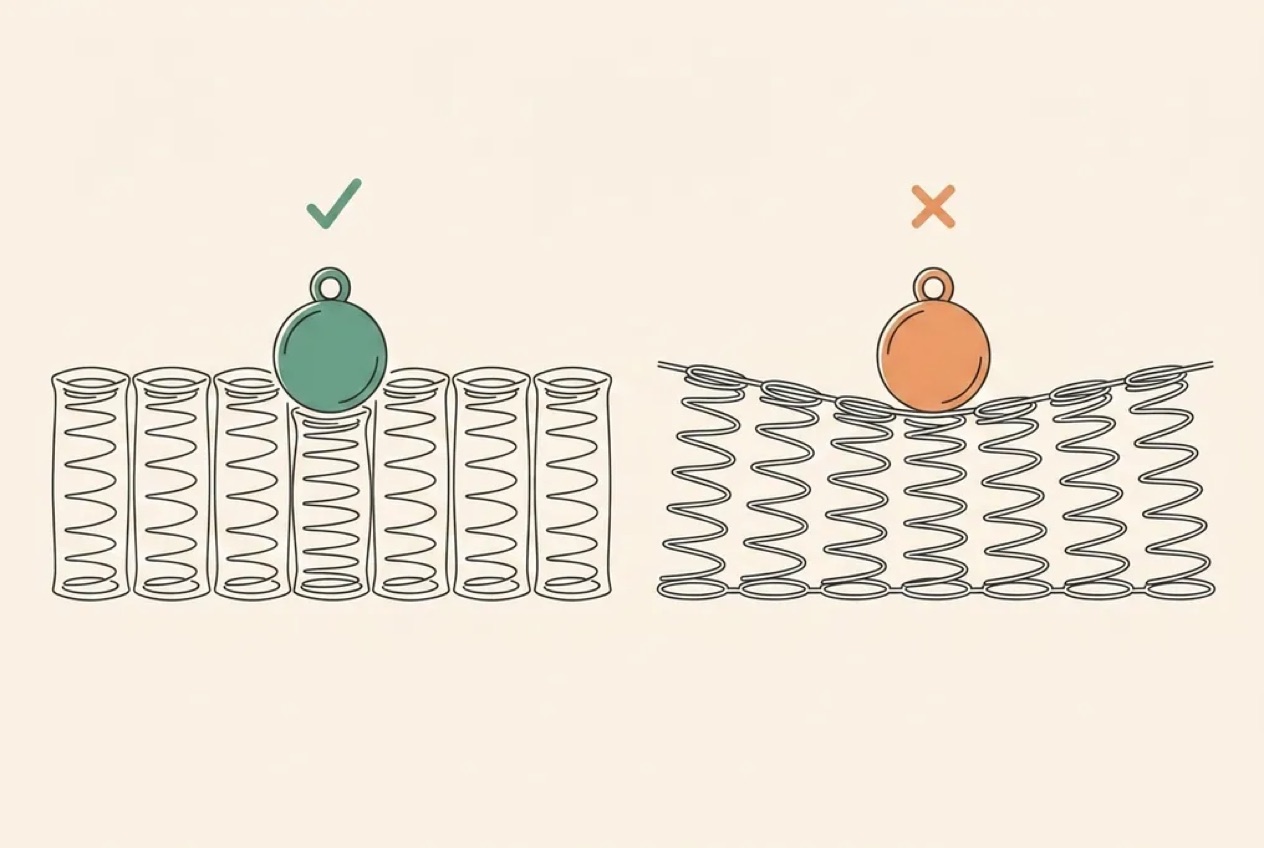
Do not confuse pocket sprung with cheap open-coil / Bonnell beds. Those connected springs drag the whole surface down together. Pocket springs — each coil in its own fabric pocket — are the gold standard for both premium innersprings and hybrids. Coil count is not a score: a well-gauged 1,000-coil unit can beat a 3,000-coil special. That is already in the layers guide.
Head-to-head comparison
Type-level differences, not product scores. Price bands match the buying-guide table. We are not inventing 8/10 ratings for a whole retail category.
| Factor | Pocket sprung | Hybrid | Notes |
|---|---|---|---|
| What Irish shops mean | Pocket coils with a thin quilt, wool, or light foam top | Pocket coils plus a substantial foam or latex comfort stack | Both use pocket springs. The comfort-layer thickness is the real split. |
| Feel | More ‘on the springs’ — bounce, less hug | Cushioned surface, still some bounce underneath | Preference, not a quality ranking. |
| Cooling | Typically cooler — thinner comfort layers, more coil airflow | Still breathable through the coils; thicker foam can sleep warmer | Irish bedrooms are mild; hot sleepers still notice a thick foam stack. |
| Pressure relief | Fair to good — depends how thin the quilt is | Better at shoulders and hips when the foam is thick enough | Side sleepers usually feel this first. |
| Motion isolation | Good with true pocket coils; thinner tops transmit more | Usually better — foam damps partner movement | Pocketed coils already beat open-coil / Bonnell beds on both types. |
| Bounce & repositioning | Higher bounce, easier to turn | Damped bounce; still easier than all-foam | Combination sleepers who hate ‘quicksand’ foam often stay on springs. |
| Edge support | Often a firmer rod or foam border on shop-floor models | Varies — some bed-in-a-box hybrids dip when you sit to dress | Build quality matters more than the category label. |
| Weight & stairs | Heavy, especially traditional non-boxed builds | Also heavy (often 30–50 kg); many compress for Irish stairwells | Neither is a one-person job on a King. |
| Typical Irish price band | €400–€2,000 | €500–€2,500 | From our buying-guide type table — not a scored ranking. |
| Noise | Can creak as the quilt thins or coils age | Foam stack usually quiets the unit; cheap coils can still squeak | Quality steel and a proper cover matter more than the marketing name. |
Honest trade-offs
Temperature
Winner as a type: pocket sprung. Less foam hugging you, more air around the coils.
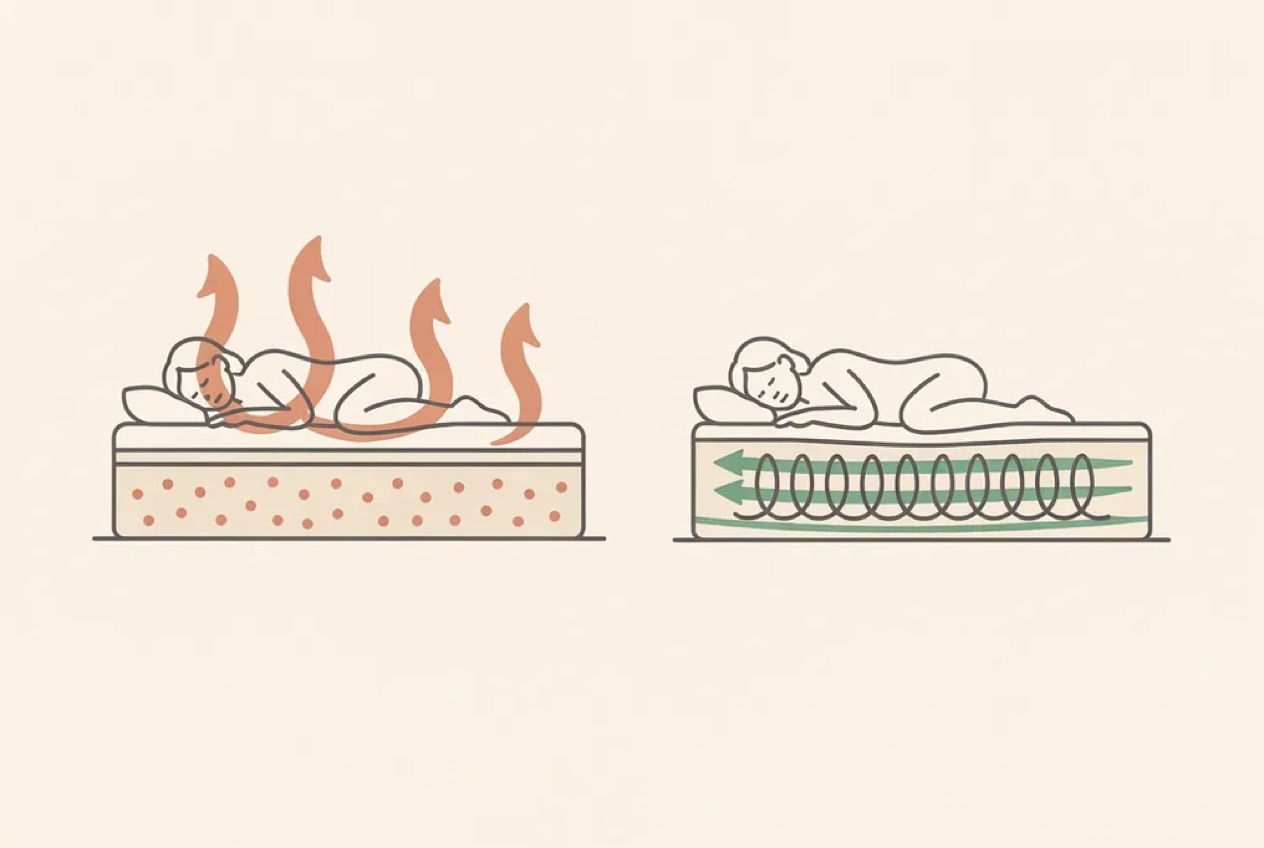
Hybrids still beat all-foam for airflow — the coil core is the chimney. They lose to a thin-quilt pocket-sprung bed if the comfort stack is memory foam. Graphite, gel, and “cooling cover” claims are product-specific; we only score those on mattresses we have slept on.
For Irish climate: mild, humid, and often a well-insulated new-build that holds heat. Overheating is less of a crisis than in hotter countries, but a thick foam hybrid in a warm room is still a hot sleeper’s problem. See bedroom temperature and the cooling roundup.
Motion isolation vs bounce
Motion: hybrid. Bounce: pocket sprung. You are trading one for the other.
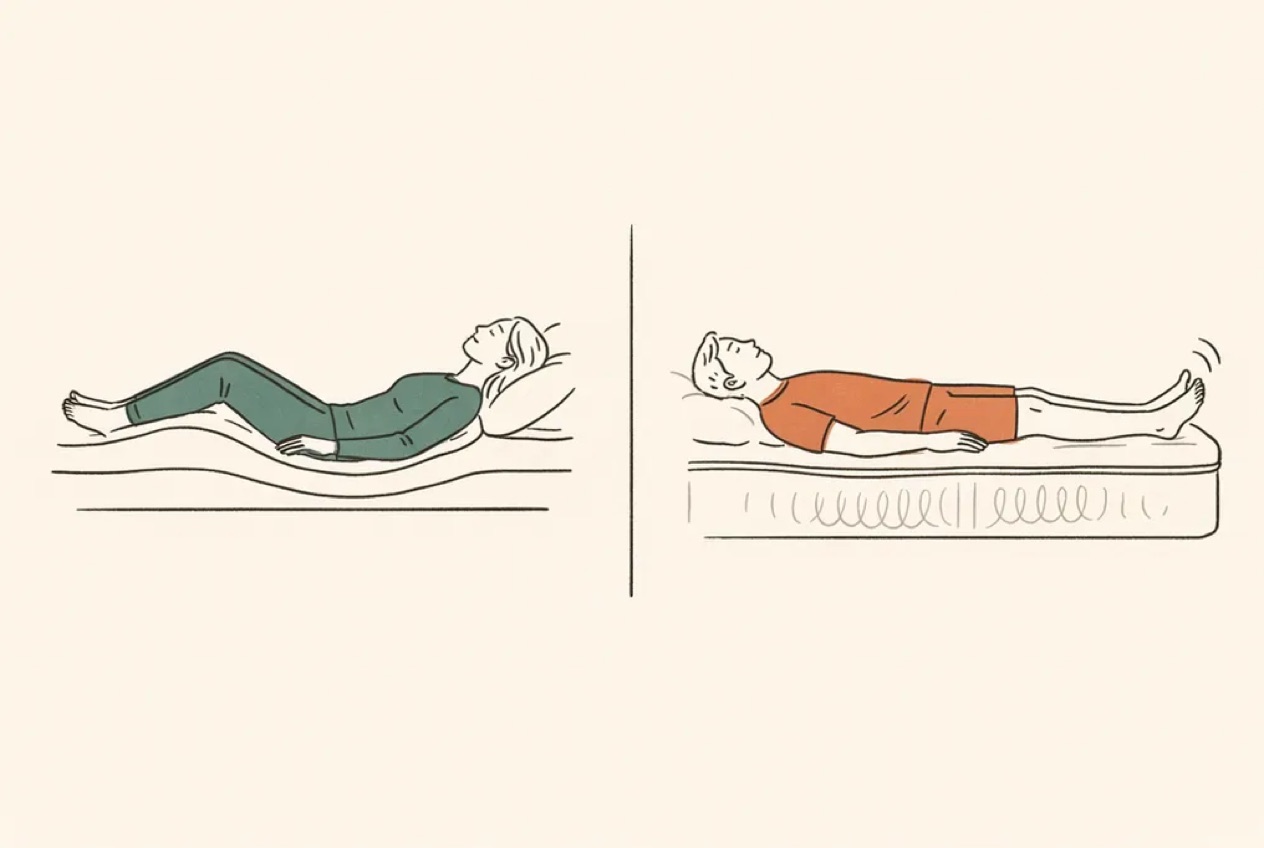
Pocketed coils already isolate better than old open springs. Add a foam comfort layer and partner movement damps further — that is why hybrids show up in our couples guide. Strip the foam back and you get the bounce combination sleepers like, and a bit more of the ripple when someone turns over.
Pressure relief and edge
Pressure relief: hybrid, when the foam is real. Edge support is a build lottery on both sides.
Side sleepers feel a thin-quilt pocket-sprung bed at the shoulder. Hybrids exist to fix that. Edge is not a category win: traditional shop-floor pocket sprung often has a firmer border; some boxed hybrids dip when you sit to dress — we measured that on specific Emma models, which is a product fact, not a hybrid law.
Durability and value
Quality beats the label. Published ranges: hybrids 7–10 years; generic innerspring 5–7 years; quality pocket springs on the layers page 8–12 years.
The 5–7 year innerspring figure on the lifespan page is the cheap open-coil end of “sprung,” not a well-made pocketed unit. A budget hybrid whose foam collapses in three years is a worse buy than an Irish pocket-sprung mattress with decent steel. Never treat coil count or “hybrid” on the ticket as a durability score.
Best choice by sleep position
Firmness still has to match body weight. This is the type tilt only — then use the firmness guide.
Side sleepers
Hybrid usuallyYou need the shoulder and hip to sink. That is the comfort layer’s job. A traditional pocket-sprung quilt is often too thin. Softer hybrids, or a medium hybrid with enough foam, are the usual Irish recommendation — same logic as the side sleeper roundup.
Back sleepers
Either, if firmness is rightThe buying guide already points back sleepers at pocket sprung and hybrid. Keep the hips from hammocking. A medium or medium-firm of either type works; the “traditional feel” crowd usually prefers pocket sprung.
Stomach sleepers
Firmer pocket sprung, or a firm hybridPelvis has to stay up. Plush hybrids fight you. A firmer pocket-sprung surface, or a firmer hybrid with a thinner comfort layer, is the safer type tilt. Heavy stomach sleepers should not buy a soft hybrid because the box says hybrid. Stomach sleeper picks.
Combination sleepers
Hybrid, unless you hate foamYou turn. Hybrids keep some bounce so you are not stuck, with enough foam that side-sleeping spells do not punish the shoulder. If foam makes you feel trapped, pocket sprung is the honest answer — you are choosing bounce over hug.
Considerations for Irish homes
Showroom vs box
Traditional pocket sprung is still a showroom category. Hybrids dominate Irish online delivery. If you need to lie on a bed before you pay, you will see more pocket sprung in person — and more hybrids arriving in a box. Trials differ: boxed hybrids often include a long home trial; many high-street pocket-sprung beds do not. Check trial policies.
Damp and airflow
Ireland’s humidity is why breathable cores matter. Pocket springs move air on both types. A solid foam block does not. If the house runs damp, a protector and a slatted base help either construction — see mattress care.
Stairs and delivery
Narrow Victorian stairs are why bed-in-a-box hybrids sell here. Traditional pocket sprung often will not compress the same way and can be a two-person, measure-the-turn job. Hybrids are still 30–50 kg once expanded. Doorstep delivery is common; carrying it up is on you.
Budget in euro
Published type bands: pocket sprung €400–€2,000, hybrid €500–€2,500. Overlap is huge. A cheap hybrid is not automatically better than a mid-range Irish pocket-sprung mattress. Spend on coil quality and, if you pick hybrid, foam you can name — not on the word on the ticket.
Advantages and disadvantages
Pocket sprung
Advantages
- • Traditional bounce and easier turning
- • Typically cooler than a thick foam hybrid
- • Familiar feel on the Irish shop floor
- • Pocketed coils already isolate better than open coil
Disadvantages
- • Less pressure relief if the quilt is thin
- • Can transmit more partner movement than a foam-topped hybrid
- • May creak as it ages
- • Awkward on narrow stairs if it does not compress
Hybrid
Advantages
- • Better cushioning at shoulders and hips
- • Coil airflow plus a comfort layer — the usual all-rounder
- • Often sold with a proper home trial online
- • Easier repositioning than all-foam
Disadvantages
- • Heavier, and the foam stack can sleep warmer
- • Typically costs more for a comparable quality coil unit
- • Edge support varies — some boxed models dip when you sit
- • “Hybrid” on a ticket is not a quality guarantee
Pocket sprung vs hybrid — common questions
Bottom line
Hybrid is the default buy in Ireland 2026 if you want cushioning, a boxed mattress, and a trial. Pocket sprung is the right buy if you want bounce and a cooler, less huggy surface — or you have found a well-made showroom coil unit and do not need the foam. Do not pay extra for the word “hybrid” on a 2 cm pillow-top. Do not avoid pocket sprung because an online quiz only talks about foam.
Last updated September 2026. Construction detail: mattress layers. If the other fork is all-foam: hybrid vs memory foam. Two hybrids we actually scored: Emma Original Pro vs Original.
Keep reading
Explore more sleep content to help you make the best choices.
Hybrid vs Memory Foam
If the other fork is all-foam, not traditional pocket sprung
Read moreUnderstanding Mattress Layers
Pocket springs, foam density, and what ‘hybrid’ actually contains
Read moreMattress Buying Guide
Type, firmness, trial, and Irish sizing in one place
Read moreEmma Original Pro vs Original
Two hybrids we actually slept on — not a type guide
Read moreBest Cooling Mattress
When heat is the whole decision, skip the category argument
Read moreFirmness by Sleep Position
The type only works if the firmness matches your weight
Read more